
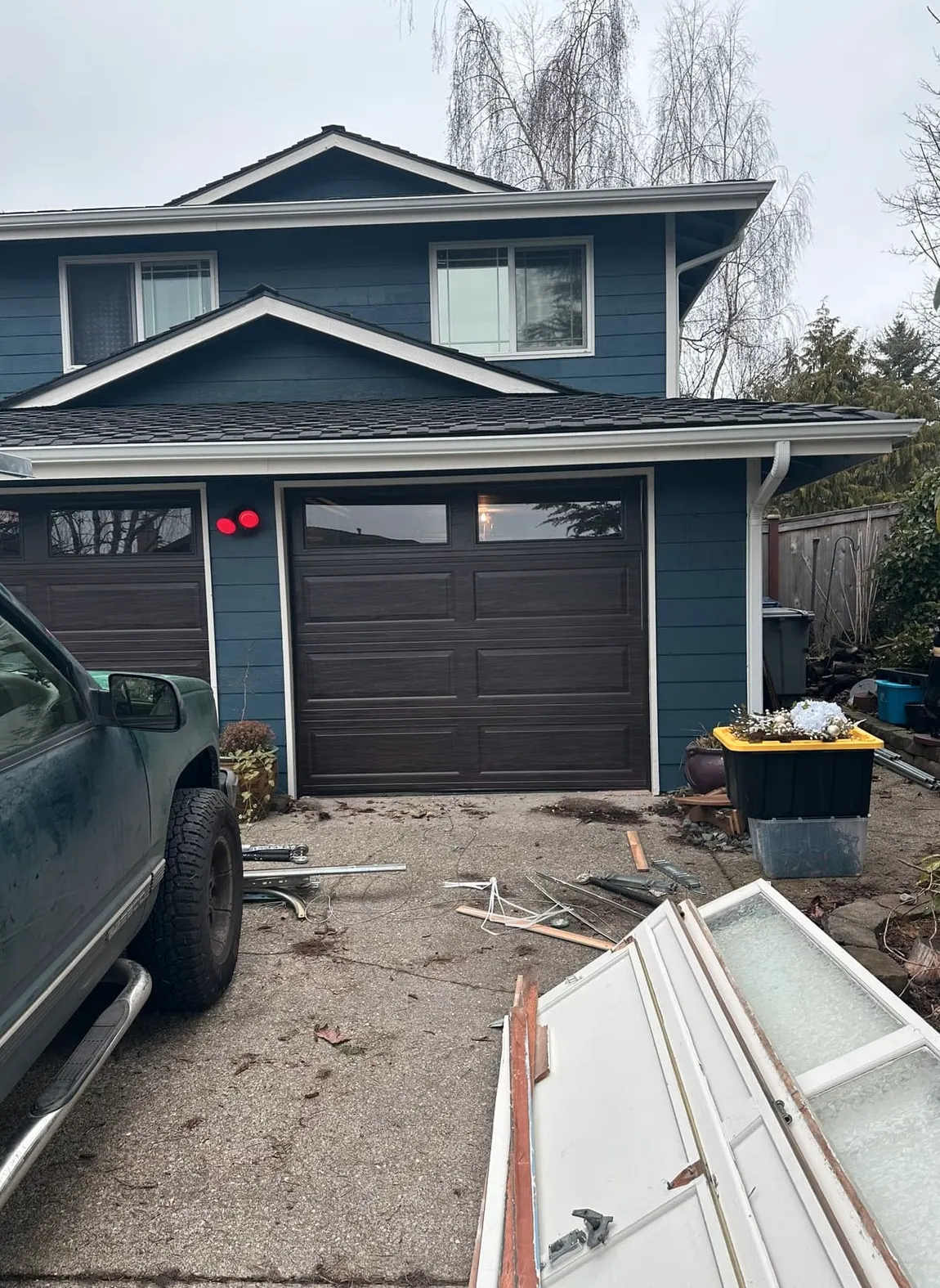
You pull into the driveway, hit the remote, and watch the door climb — except now there's a dent the size of a dinner plate where your neighbor's trash can blew into it during last week's storm. Or maybe it's not storm damage at all. Maybe you backed out a little too fast with the door only half up, and one panel now has a crease running clean across it. Either way, you're standing in the driveway asking the same question most homeowners ask the first time this happens: do I really need a whole new door for one bent panel?
The honest answer is: it depends on the door, the damage, and how long you plan to keep the house. Here's how the two options actually compare.
Replacing Just the Damaged Panel
Garage doors are built in horizontal sections, so in theory, swapping one section is a contained job. A technician unbolts the hinges holding that panel to its neighbors, lifts it out, and bolts in a replacement.
Where this works well
- The door is relatively new. If it's a few years old and the manufacturer still produces that model, the color and panel profile will match closely.
- The damage is cosmetic or localized. A dent, a crack, or a hole from a flying branch that hasn't bent the track or thrown the door out of square.
- Only one section is affected. Hail, a stray baseball, or a bumper tap usually hits one panel, not the whole door.
Where it gets complicated
- Fading. South Florida sun is hard on paint and finish. A door that's five-plus years old will almost always show a visible color difference between the old, sun-faded panels and a brand-new replacement — even with the exact same paint code.
- Discontinued styles. If the door is older, the manufacturer may have changed panel designs, window inserts, or hardware spacing, making a true match impossible.
- Hidden damage. A hard impact can tweak the track, bend a hinge, or stress the opposite panel in ways that aren't obvious until the door starts binding weeks later.
Replacing the Whole Door
This is the bigger job — removing the entire door, tracks, and sometimes the opener mounting — but it solves more than one problem at once.
Where this makes sense
- The door is older or already showing its age. Chalky paint, surface rust spots, or sections that don't sit flush anymore. One repaired panel on a tired door just highlights how worn the rest of it is.
- You're near the coast. Salt air accelerates corrosion on hardware, hinges, and steel skins. If you're seeing rust bubbling up on more than one panel, that's a sign the whole door is reaching the end of its service life, not just the damaged section.
- Wind rating matters. Homes in hurricane-prone areas need garage doors rated for wind load as a complete system — the panels, track, and hardware are engineered together. Mixing an old panel's wear with new hardware, or patching in a panel from a different production run, can compromise how the whole door performs under wind pressure. If your current door predates today's wind-load standards, a single-panel patch doesn't bring it up to current performance; a full replacement does.
- Multiple panels are affected or the track, rollers, or opener are already due for attention. It's often more cost-effective to handle it all in one visit than to pay for a service call now and another one next year.
The Trade-offs, Side by Side
- Cost: A single panel swap is typically a fraction of what a full door costs — national ranges for a panel replacement run roughly $250–$800 depending on size and insulation, while a full door replacement is commonly $1,000–$3,500+ depending on material and features. A panel repair is the cheaper fix today.
- Appearance: A new door gives you uniform color and finish. A patched panel is a visible trade-off, especially once FL sun has faded the rest of the door.
- Longevity: A full replacement resets the clock on springs, rollers, and weatherstripping too, which matters in a climate where humidity and salt air wear those parts down faster.
- Storm readiness: If wind rating or structural integrity is in question, only a full door replacement guarantees the whole system is rated and performing as one unit.
Our Recommendation for Most Boynton Beach Homes
If your door is under about five years old, the damage is limited to one panel, and the rest of the door is in good shape, a panel replacement is usually the practical, budget-friendly call. If the door is older, shows rust or fading, sits close to the coast, or you're not confident it meets current wind-load expectations, it's worth treating this damage as the nudge to replace the whole door before hurricane season puts it to the test.
When to Call Boynton Beach Overhead Door Co
If you're staring at a dented or cracked panel and not sure which way to go, that's exactly the call we're set up for. Our Garage Door Repair technicians can look at the damage in person, check the track and hardware for hidden stress, and tell you honestly whether a panel swap will hold up or whether it's time to talk through Garage Door Installation options — including wind-load-rated doors built for what South Florida storms throw at them.
Don't let a dented panel turn into a bigger problem once the next storm rolls through. Call Boynton Beach Overhead Door Co today and we'll get your garage door sorted out right, whether that's one panel or the whole thing.